Welcome to Volt Energy Technology
Who Invented the Electric Drill?
Who Invented the Electric Drill? Let’s Talk About Electric Drills
Hey everyone! Today, let’s chat about something we often use in DIY projects or work—electric drills. But before we dive into electric drills, have you ever wondered how our ancestors drilled holes?
Way back around 35,000 BCE, humans figured out that if they held a hard object and spun it nonstop against another material, they could make a hole. Just imagine those early days: people rubbed hard objects with their hands until their palms were sore and blistered! Later, they got smarter—they tied a piece of wood with a rope and used a pulling-and-releasing motion to spin the wood, which even helped them start fires (you know, the classic “drilling wood for fire” method). That was the first step toward “drilling tools” in human history.
Now, let’s fast forward to the 19th century—the era when the electric drill was born. Many people might wonder, “Who actually invented the electric drill?” Let’s clear that up.
First, in 1889, an inventor named Arthur James Arnot (who was born in England but based in Australia) filed a patent for the world’s first electric drill. This early drill used compressed air as its power source and had a hollow handle to store the air. It was originally designed for drilling rocks and coal, and while it’s not exactly the portable electric drill we know today, it laid the solid foundation for all electric drills that came after.
Then, in 1895, a German inventor named Wilhelm Emil Fein stepped up. He created the world’s first pistol-shaped DC electric drill. This drill combined an electric motor with a manual drill, but it was pretty bulky—made of cast iron, it weighed a whopping 14 kg! It also needed multiple people to operate and could only drill 4mm holes in steel plates. Plus, its power was weak, and its speed was slow (less than 3000 rpm). But even so, this drill dominated the market for nearly 20 years—it was a big leap from manual drilling!
As time went on, electric drills got better and better, especially when it came to being portable. In 1916, the American company Black & Decker made a game-changing move: they invented the portable electric drill with a hand grip and a trigger switch. They even developed a special universal motor for it that works with both AC and DC power. Before this, drills were hard to handle, but Black & Decker’s design fixed that—this portable electric drill weighed 9.75 kg (way lighter than Fein’s 14 kg one!) and became super popular in industries. It also set a standard: that trigger switch? We still see it on electric drills today!
And let’s not forget the 1917 invention by a German named Blank—he created the gun-shaped electric drill. That sleek, practical design was such a hit that it’s still used worldwide now.
Now, let’s talk about the big shift that changed everything: the move to cordless electric drills. Before cordless models, electric drills were tied to power outlets—super inconvenient if you needed to work outside or in places without electricity.
The first breakthrough came in 1961, when Black & Decker launched the world’s first cordless electric drill powered by nickel-cadmium (Ni-Cd) batteries. Sure, the battery only had less than 20 watts of power, but they improved efficiency by adjusting gear ratios and using better materials. This was a revolution for DIY lovers—suddenly, you could take your drill anywhere!
Later, brands like Makita joined the cordless game. In 1969, Makita released the global’s first rechargeable electric drill, the 6500D. By 1978, they had a Ni-Cd battery impact drill (the 6010D), and in 1997, they upgraded to nickel-metal hydride (Ni-Mh) batteries with the 6213D—faster and more powerful. Then, in 2005, Makita made another big step: the world’s first lithium-ion (Li-ion) battery screwdriver-drill, the TD130D. Lithium-ion batteries are lighter, hold a charge longer, and charge faster—this took cordless electric drills to a whole new level.
From the heavy, wired drills of the 19th century to today’s lightweight, powerful cordless electric drills and portable electric drills, this tool has come a long way. It’s no longer just for professionals—whether you’re hanging shelves at home, fixing a bike, or working on a construction site, an electric drill is a must-have.
If you’re looking for high-quality electric drills—whether you need a reliable portable electric drill for on-the-go jobs or a long-lasting cordless electric drill for DIY projects—our company has got you covered. Our electric drills are designed with the latest lithium-ion battery tech, so they’re lightweight, powerful, and easy to use. They’re built to handle both daily DIY tasks and heavy-duty work, making them perfect for homeowners, DIY enthusiasts, and professionals alike. Want to make your projects easier and more efficient? Check out our electric drill products today—you won’t be disappointed!
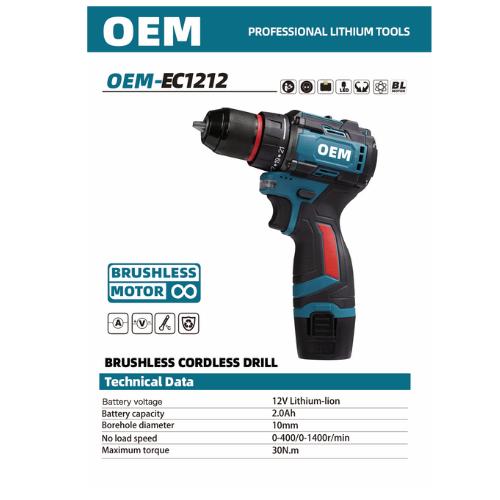
OEM-EC1212 12V portable electric drill
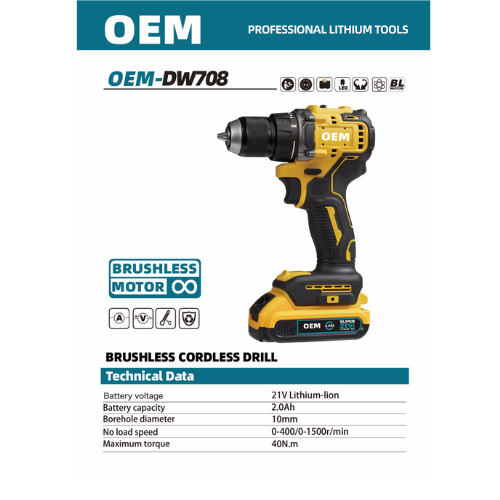
OEM-DW708 electric drill cordless
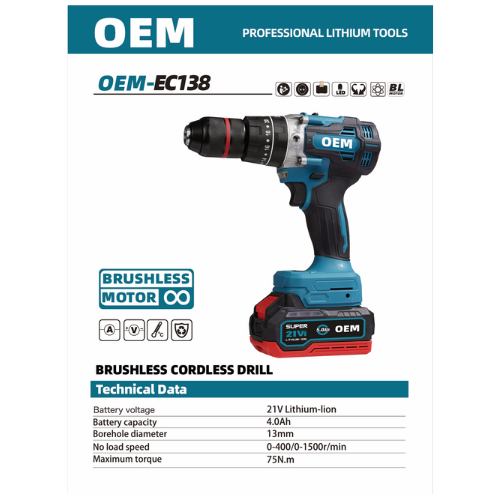
OEM-EC138 High-Torque Brushless electric drill cordless

 English
 العربية
 Español
 Русский